King Arthur doesn’t stay dead. Most ancient rulers eventually become museum exhibits or boring exam questions. Arthur? He keeps showing up — in Netflix series, blockbuster movies, comic books, fantasy novels, strategy games, and even random late-night Reddit threads about what real leadership looks like.
It’s not really about the sword in the stone. It’s not about Camelot’s golden halls or the tragic love triangle. It’s about one single, stubborn line that’s been whispered for more than fifteen hundred years:
He’ll come back.
Not “he was amazing once.” Not “he fought well and died.” But he will return — exactly when the world is broken enough to need him.
That promise turns Arthur from a historical footnote into something alive, unfinished, and quietly hopeful.
How the Promise Was Born
Picture Britain after the Romans left. Everything collapsed. Saxon invaders swept in. Celtic communities were pushed into the corners of Wales, Cornwall, and Brittany. Families were slaughtered or enslaved. Sacred groves were burned. It felt like the end of their entire way of life.
When a culture is dying, people don’t just want history lessons. They want something to hold onto. They want a hero who refuses to stay buried.
The earliest written hint appears around 1136 in Geoffrey of Monmouth’s History of the Kings of Britain. Arthur is badly wounded at his final battle and carried away to the mysterious island of Avalon. Geoffrey never says he dies. He just… leaves the door open.
By 1485, Thomas Malory’s Le Morte d’Arthur makes the promise official. On Arthur’s tomb, a simple inscription reads:
“Hic jacet Arthurus, Rex quondam, Rexque futurus.” Here lies Arthur, the once and future king.
Not the king who ruled long ago. The king who is still coming.
The Time Arthur Actually Did Come Back (Victorian Britain)
Arthur has already returned — just not on horseback.
In the 1800s, Britain was changing faster than anyone could handle. Factories blackened the sky. Cities became overcrowded nightmares. Old rural life vanished. Many felt the country was losing its moral center.
So poets, painters, and writers reached back to the Middle Ages and pulled Arthur forward — but they remade him in their own image.
Alfred Lord Tennyson’s Idylls of the King turned Arthur into the ultimate symbol of moral strength: a king fighting to hold back chaos and human weakness. The Pre-Raphaelite painters gave us glowing, almost magical images of knights and ladies — dreamlike visions of a purer, nobler past.
This wasn’t just pretty art. It was emotional medicine for a nervous nation. Victorians used Arthur to teach their children about duty, honor, loyalty, and proper behavior. They used him to remind themselves what Britain could still be.
The Arthur they created wasn’t exactly the rough Celtic chieftain of the old Welsh tales. He was cleaner, more romantic, more Victorian. But that version became so powerful that it still shapes how most people picture Camelot today.
Arthur in Our Time: From Spaceships to Smartphone Screens
The promise never had an expiration date.
In 1982, the comic Camelot 3000 woke Arthur up in the year 3000 to fight an alien invasion. Merlin cast spells. Morgan le Fay schemed. Excalibur glowed. But now they stood beside laser rifles and starfighters.
It was absurd — and perfect.
Because Arthur doesn’t belong to any single century. He appears wherever things feel hopeless enough.
Science fiction has put him in dystopian futures, leading resistance against tyrannical governments. Fantasy writers have dropped him into modern Britain to fight hidden evils. Comics have turned him into a superhero, a detective, even a high-school kid discovering his destiny.
And now? He’s literally in your hand.
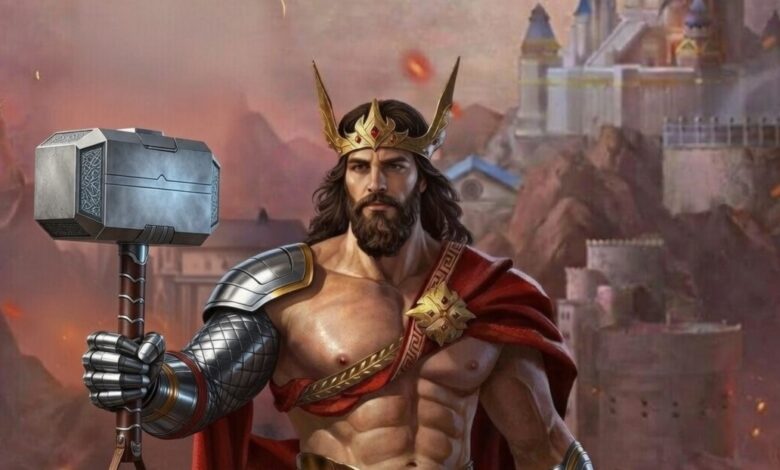
In mobile games like Evony: The King’s Return, players summon Arthur as one of the historic generals. You can upgrade him, equip him with gear, send him charging into battle alongside George Washington, Julius Caesar, Genghis Khan, and Oda Nobunaga.
It sounds like a cash-grab crossover — until you realize how perfectly it fits.
A strategy game is a modern kind of Avalon: A place outside normal time. A space where legendary figures wait to be called. A world where regular people get to play at being kings.
Every time someone recruits Arthur, levels him up, and watches him lead a rally or defend a city — the once and future king returns again. Not riding out of the mist, but stepping out of a glowing screen.
What We’re Really Waiting For
We don’t actually expect a man in shining armor to gallop out of the fog and fix the world.
That’s not what the promise means anymore.
Arthur has always stood for something bigger:
- The refusal to accept that cruelty always wins
- The stubborn belief that justice isn’t finished
- The quiet courage to stand up when everyone else is sitting down or running away
- The hope that decency still has a chance
Every time someone fights for fairness in a broken system… Every time a group protects the vulnerable instead of looking away… Every time a person chooses integrity when lying would be easier and more profitable…
That’s Arthur returning.
Not with a sword. Not with a crown. But in the small, human decision to keep trying.
Why the Legend Won’t Let Go
The world still feels uncertain — it always has. Every generation thinks they’re living through the hardest, most chaotic time.
And every generation finds a way to bring Arthur back.
Because deep down, we’re not waiting for a literal king. We’re waiting for the feeling that goodness isn’t permanently defeated. That courage still matters. That even when everything looks dark, someone — somewhere — is still willing to stand up.
As long as we keep hoping for that… As long as we keep choosing decency when it would be easier not to… The Once and Future King will never really be gone.
He’s just waiting for his next moment. And maybe — just maybe — that moment is now.